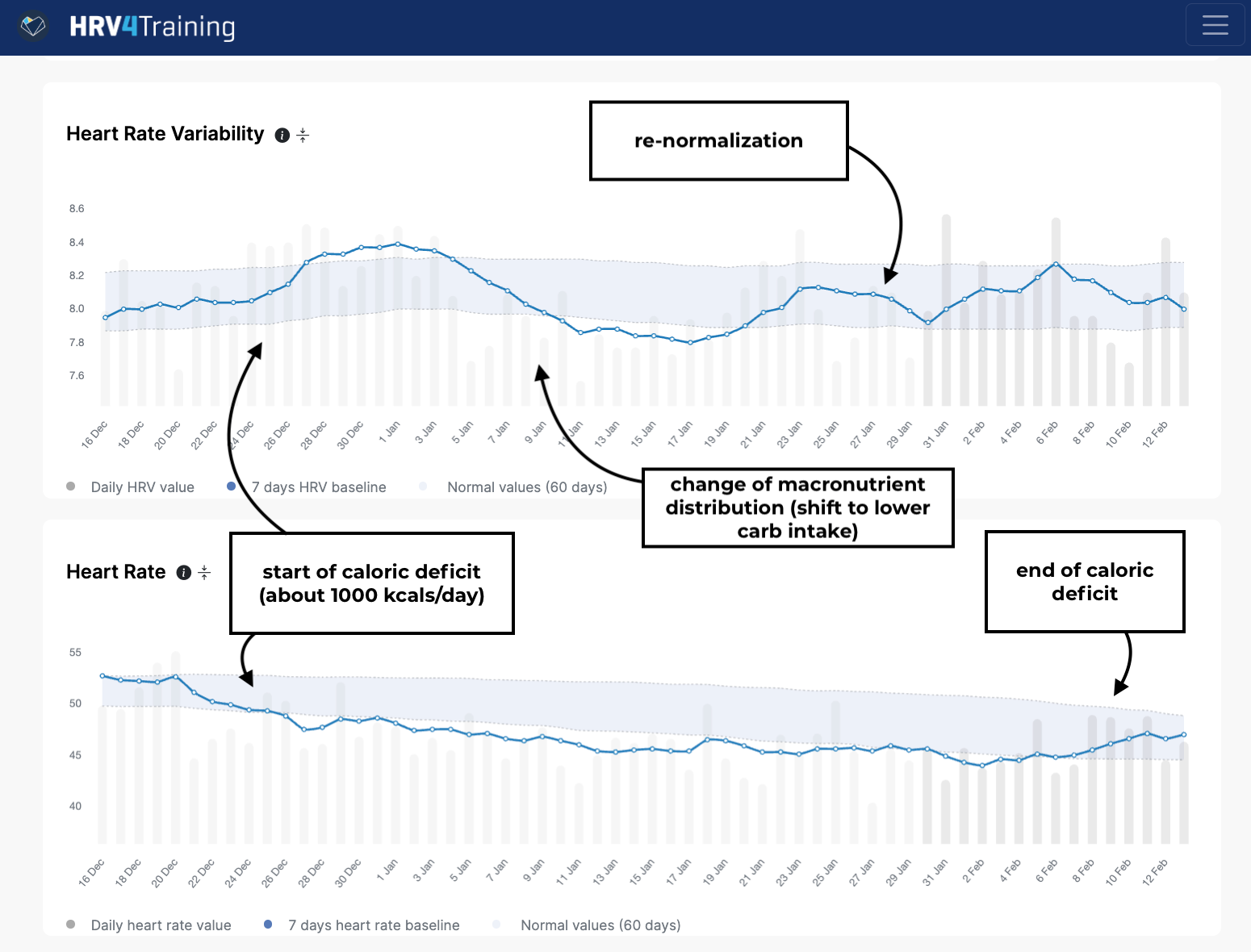
When someone transitions from carbohydrate-based metabolism to fat oxidation, the most noticeable change doesn’t first appear in body weight—it shows up in cardiovascular and nervous-system responses. Heart-rate behavior almost immediately signals how “safe” the body feels in terms of energy availability.
In carbohydrate-dependent mode, the body operates with relatively narrow energy reserves. Glycogen stores are limited and gradually deplete during prolonged effort. As this happens, the nervous system interprets the emerging energy shortage as a threat. The stress response activates: cortisol and adrenaline rise, and heart rate creeps steadily higher—even when pace remains constant. This is known as heart-rate drift.
In this scenario, it’s not the muscles that fatigue first—it’s the nervous system switching into emergency mode.
In a fat-oxidation-adapted state, the situation is fundamentally different. The body no longer relies on a few hundred grams of carbohydrate; it has continuous access to tens of thousands of calories stored as fat. Energy supply doesn’t bottleneck during effort, so the nervous system doesn’t perceive a threat. One of the most visible consequences is the stabilization of heart rate.
During long runs or workouts, heart rate remains far more even, with smaller fluctuations and often at a lower average value. This isn’t because the person is “working slower”—it’s because the body produces energy more efficiently and with less stress.
At the same time, the nervous system’s recovery capacity improves. This is clearly reflected in rising HRV (heart-rate variability). Higher HRV indicates stronger parasympathetic (rest-and-digest, recovery-oriented) tone, while the chronic stress response diminishes. Put simply: the body returns to calm much faster after load.
In practice, this means a long or intense session doesn’t “drain” the person. Instead, heart rate often returns to baseline surprisingly quickly, well-being improves, and the next day there’s usually no classic exhaustion hangover.
It’s important to understand that this isn’t a training trick—it’s a metabolic-state phenomenon. The exact same well-trained athlete in carbohydrate-dependent mode will hit nervous-system overload much sooner, whereas in fat-adapted mode they can handle load far more stably.
This is where the functional carnivore approach truly becomes a performance system. It’s not just the fuel that changes—it’s the entire stress-management machinery. The body doesn’t panic over energy shortage, so it doesn’t need to artificially rev itself up with hormones.
Heart rate becomes more stable. Recovery accelerates. The nervous system stays calmer.
And over the long term, this is exactly what enables high-volume training without overtraining.